

The mobile application development industry has embraced sophisticated content processing tools to enhance user experience and streamline development workflows across various platforms. Development teams worldwide now utilize advanced systems to humanize AI-generated content, transforming algorithmic outputs into natural, engaging text that resonates with app users and improves overall application usability.
Professional developers integrate humanized AI solutions into their content management systems to scale personalization efforts while preserving the human connection that drives user engagement and retention. The adoption of these technologies has revolutionized how apps communicate with users, enabling more sophisticated and personalized experiences that adapt to individual preferences and usage patterns.
Early Mobile Platform Limitations
The first generation of mobile applications operated within severe hardware constraints that required developers to optimize every line of code for minimal memory usage and processing power. Early smartphones featured limited storage capacity, slow processors, and basic graphics capabilities that restricted app functionality to simple utilities and basic games. Internet connectivity relied on slower data networks that made real-time features challenging to implement effectively.
Battery life considerations forced developers to minimize background processing and limit resource-intensive features that could drain devices quickly.
User interfaces remained simple due to small screen sizes and limited touch sensitivity, requiring careful design decisions to ensure usability within these constraints.
Network Connectivity Revolution Impact
The transition from 2G to 3G networks enabled more sophisticated mobile applications that could leverage real-time data synchronization and multimedia content delivery. Faster data speeds allowed developers to implement features like live streaming, video calling, and social media integration that were previously impossible on mobile platforms. Cloud services integration became feasible as reliable internet connections supported seamless data backup and cross-device synchronization.
Location-based services emerged as GPS capabilities combined with improved network speeds to enable navigation apps, location sharing, and geographically relevant content delivery. Push notification systems became practical as persistent network connections allowed servers to communicate with mobile devices even when apps weren’t actively running.
Touchscreen Interface Evolution
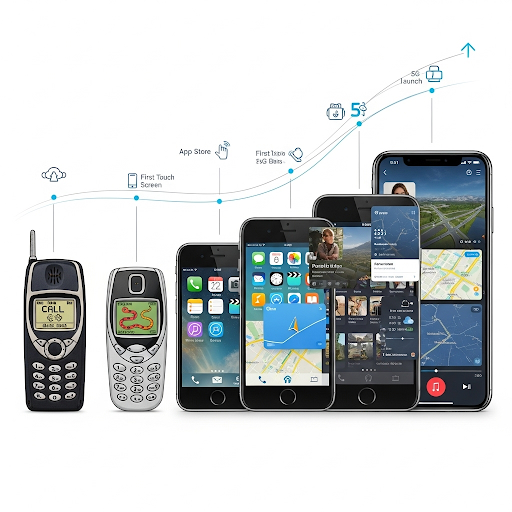
Multi-touch capabilities transformed user interaction paradigms, enabling intuitive gestures like pinch-to-zoom, swiping, and complex multi-finger controls that created more natural user experiences. Capacitive touchscreens provided precise input recognition that supported detailed drawing applications, handwriting recognition, and sophisticated gaming controls. Screen size increases allowed for more complex user interfaces while maintaining touch accuracy and usability.
Haptic feedback integration enhanced user interactions by providing tactile responses that confirmed touch inputs and created more engaging experiences. Pressure-sensitive displays introduced force touch capabilities that added new dimensions to user interaction and enabled context-sensitive controls.
Advanced Processing Power Integration
Modern smartphone processors rival desktop computers in computational capability, enabling mobile applications to perform complex calculations, machine learning inference, and real-time graphics rendering previously reserved for powerful workstations. Multi-core architectures allow apps to perform background tasks while maintaining responsive user interfaces, improving multitasking capabilities and overall user experience.
Dedicated graphics processing units in mobile devices support high-quality gaming, augmented reality applications, and sophisticated visual effects that create console-quality experiences on portable platforms. Specialized AI chips enable on-device machine learning processing that enhances privacy while providing intelligent features like voice recognition and image analysis.